Somewhere between preschool and elementary school, kids start getting a little more ambitious with their art. They want to make things that look a certain way. They want to build elaborate cardboard creations, draw their favorite characters, experiment with new materials, and spend an entire afternoon working on one very important project that they have been thinking about for three days.
It's a really fun age for art.
It's also an age when having the right materials available can make a big difference. I'm not talking about expensive craft kits or supplies that promise to teach your child how to draw a perfect horse in six easy steps. I'm talking about materials that are satisfying to use, offer lots of possibilities, and let kids take their ideas in whatever direction they want.
I've spent more than a decade teaching art to children, and I've seen how much the quality of a material can affect a child's experience. Sometimes spending a little more is absolutely worth it. Sometimes the inexpensive option is perfectly fine. And sometimes a tool that seems pretty ordinary can unlock a whole new category of projects.
Here are the things I'd recommend adding to your art space for kids ages 6–10.
First, a few favorites that grow with your child
If you read my guide to art supplies for kids ages 3–5, you'll recognize a few of these. The good news is that you don't need to replace everything as your child gets older. Plenty of quality materials for preschoolers are just as useful for elementary-age kids, and they're especially handy if you have children of different ages sharing an art space.
Faber-Castell tempera paint pans
These are still a great choice for older kids. They're convenient, easy to store, and offer much better color than the really inexpensive watercolor-style paint palettes you sometimes find in kids' art sets.
Good-quality paintbrushes
A comfortable brush that holds paint and makes a nice mark is still a good brush! You don't need to replace your brushes just because your child is no longer in preschool. These ones I recommended for preschoolers are still a great choice for elementary aged kids, or these are nice if you’re getting a new set for an older child. A variety of shapes and sizes is important because small brushes work better in small spaces, big brushes work better in big spaces, and sometimes a flat brush or a round brush makes all the difference. Honestly I’m not a brand loyalist, just please don’t give your child those terrible brushes with plastic bristles that look like they’ve been stuck in an electrical outlet that come in a cheap watercolor set.
Heavyweight painting paper
If you're going to paint, use paper that can actually handle it. Lightweight paper gets soggy, wrinkles, and tears, which can make painting unnecessarily frustrating. A heavier paper gives children more freedom to experiment without the paper falling apart halfway through. This is my favorite good value painting paper. Start with one pad, but if you have a prolific painter in your life, spring for the 250-sheet pack. Make it easy to experiment without feeling precious about each page.
Pacon Tru-Ray construction paper
This is one of those upgrades you might not think matters until you've seen the difference. A lot of inexpensive construction paper fades surprisingly quickly, especially when artwork is displayed in a sunny spot. Tru-Ray is designed to resist fading, so those colorful collages and masterpieces have a much better chance of staying colorful.
Crayola Super Washable Markers
Still a perfectly good staple. I love a fancy art supply as much as the next art teacher, but you don't need to spend extra money on everything. Crayola Super Washable Markers are still reliable, colorful, and easy to clean up. Save your upgrade budget for the materials where quality really makes a difference.
Now, onto the new supplies for older kids doing more ambitious things!
Painting, color, and experimentation
1. Liquid tempera paint
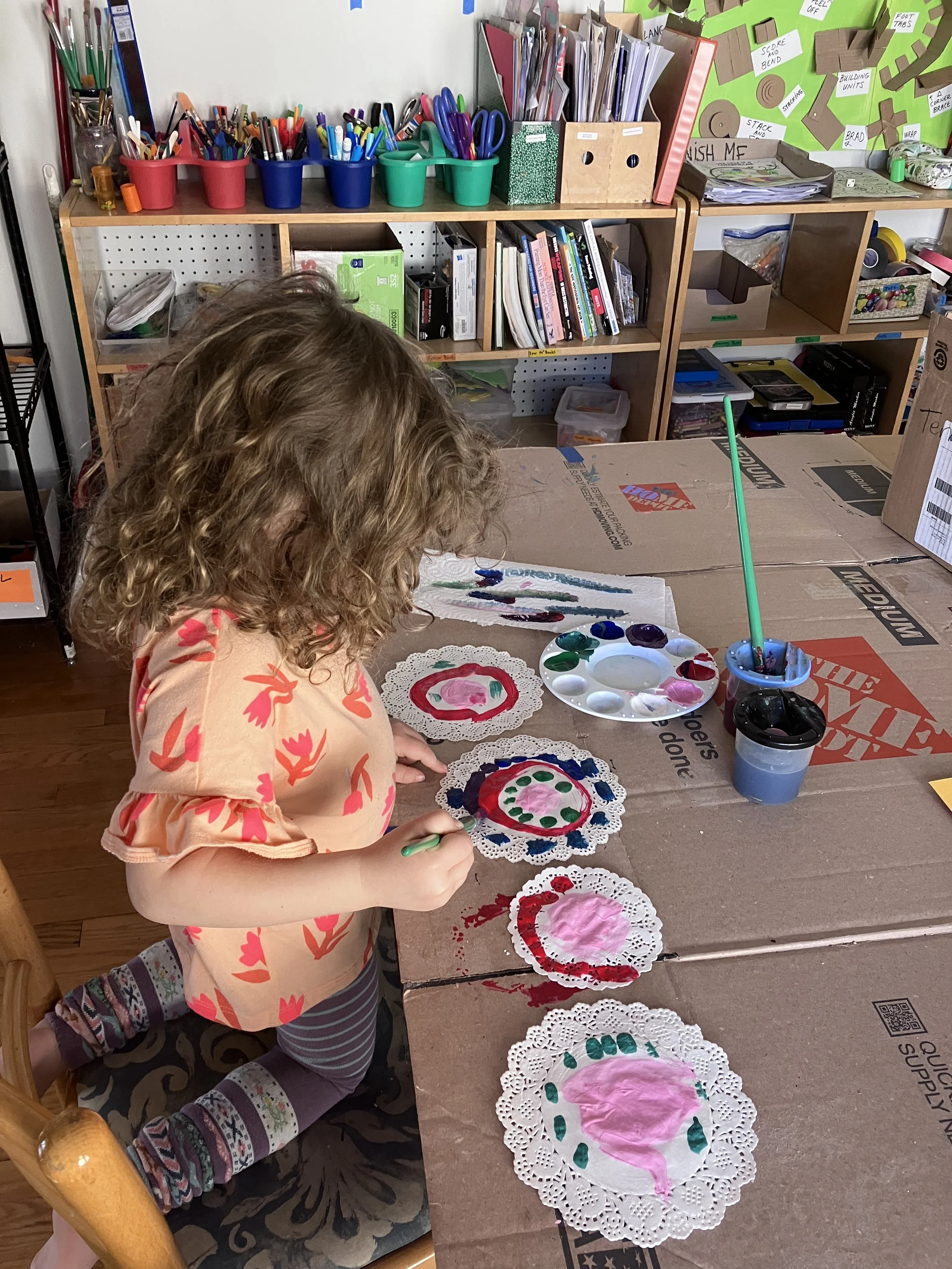
Paint pans are convenient, but there's something wonderful about having actual liquid paint available, especially when kids are ready to work on bigger paintings or experiment with mixing colors.
I like Sax the best. This is one area where I think spending a little more on a reputable brand is worth it. You want paint with good coverage and rich pigmentation. Really thin, translucent paint can be disappointing, especially when children are trying to cover a large area, or want to mix colors and get the result they're imagining. Nobody wants a thin yellow paint that’s barely visible over cardboard when they’re turning your latest delivery into a rocket ship.
A little studio tip: skip the tiny paint palettes with the little individual wells. They can be surprisingly difficult for kids to use, especially once they start mixing colors. A muffin tin from the thrift store or dollar store makes a fantastic paint palette. An old egg carton can work, too. You get more room for mixing, and it's easy to see and access all the colors.
2. Acrylic paint pens
I really love acrylic paint pens for this age group. They're a fun way to add details, patterns, lettering, and bold blocks of color without having to set up a whole painting station.
You absolutely do not need to buy expensive Posca markers for a seven-year-old. There are plenty of more affordable sets that work beautifully for kids. Look for opaque acrylic paint pens that give good coverage. Having tried lots of different brands, once again I’m not a huge brand loyalist but I no longer buy dual tip paint pens as it’s just twice as many opportunities for caps to get lost while they’re drawing, and smashing a fine line cap onto a brush tip marker just ruins the brush. Usually I’m a fan of buying a smaller set of high quality supplies vs. a huge variety of colors in a cheaper set, but my experience is that all acrylic markers have a limited shelf life with kids, and a set with lots of colors is more fun since they don’t blend like regular wet paint. So I’ll get a huge set of single-tip markers and let the kids go nuts. Then when one purple marker gets too clogged or dried out, we still have plenty of other purples to choose from.
One of my favorite ways to use them is on black construction paper. The bright colors really pop, and it's a fun way to get kids thinking about contrast and how the color of the paper changes the look of their work.
Drawing and expressive mark-making
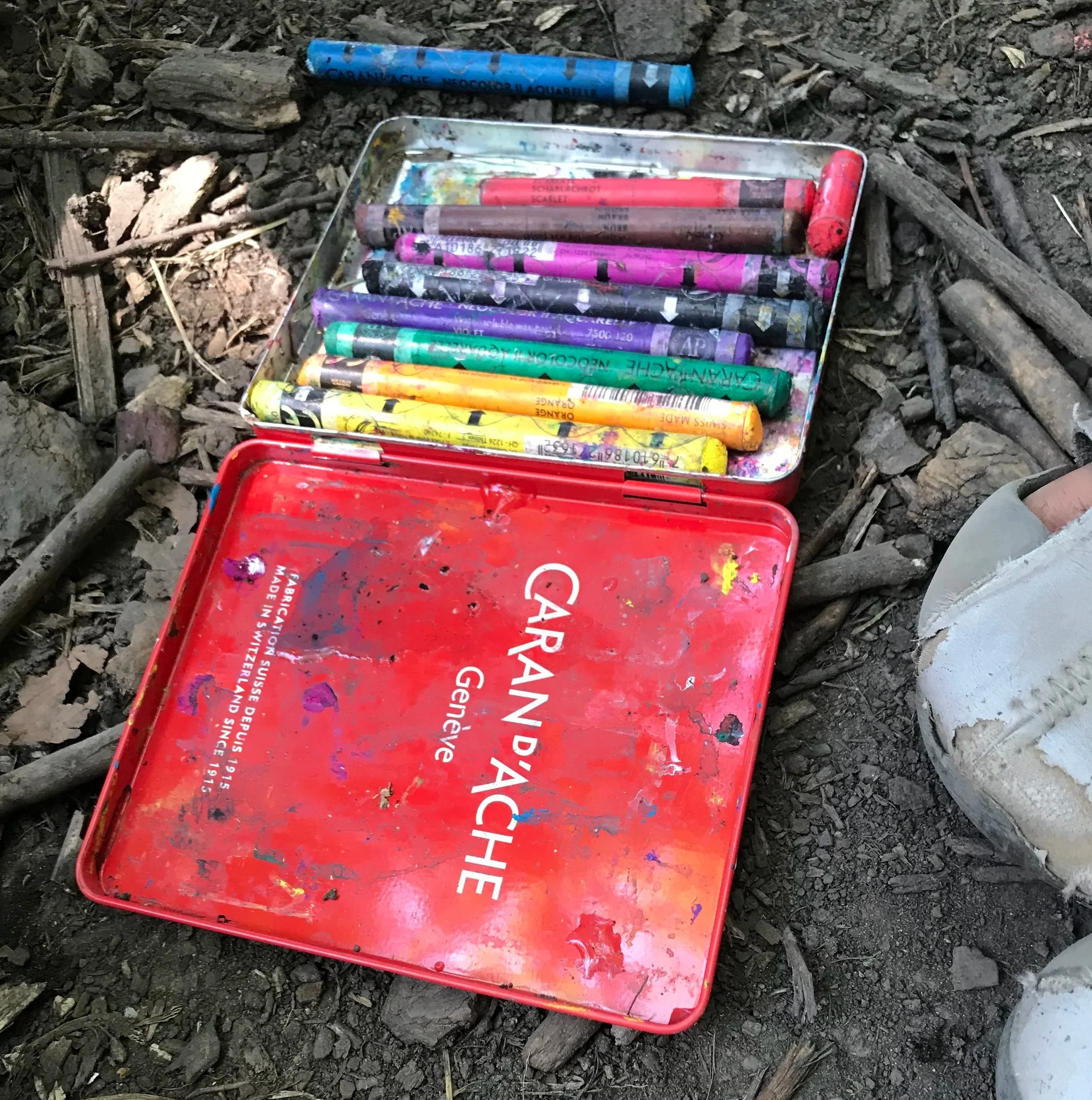
3. Caran d'Ache water-soluble pastel sticks
These are a little more of an investment, but they're one of those art materials that can make a child say, "Wait, that's so cool."
Caran d'Ache makes beautifully pigmented water-soluble pastel sticks that are easy to use and incredibly satisfying. While the Kwik Stix tempera sticks I recommended for younger kids are still really fun for big kids, these are like the cool sophisticated older cousin of brightly colored paint-based drawing supplies.
Kids can draw with them like a regular pastel or crayon, then use a wet brush to transform their marks into something that looks more like a watercolor painting. Or try drawing on wet paper. Or try dipping them in water. So many ways to explore the physical possibilities of the material!
I especially like these for kids who enjoy seeing an immediate, dramatic result. They're easier to work with than traditional watercolor pencils if you're looking for bold color without a lot of careful, detailed drawing.
4. Oil pastels
Oil pastels are such a fun material for elementary-age kids. They're creamy, colorful, and make a much more substantial mark than a regular crayon. Kids can layer colors, blend them together, experiment with texture, and make really expressive drawings.
I'd look for a student-grade set with smooth application and good pigmentation. Pentel is a great choice. You don't need expensive professional pastels that cost several dollars each, but I'd avoid the really cheap sets that feel grainy or barely leave any color behind.
One of the best things about oil pastels is how well they work for mixed media. Try drawing with them and then painting over the top with watercolor. The pastel marks resist the watercolor, creating a really satisfying effect. It's a great opportunity to let kids put on their science brains and experiment with what happens when different materials interact.
5. Prismacolor colored pencils
Here's where I'm going to be a little opinionated: please don't buy your elementary-age child the cheapest colored pencils you can find. And while I love Crayola for plenty of things, I would skip their colored pencils and spring for Prismacolor.
The difference is genuinely worth it.
Good colored pencils leave behind rich, vibrant pigment without requiring a child to press incredibly hard. They're smoother to use, easier to blend, and much more satisfying when kids want to layer colors or create subtle changes in shading.
I've seen so many children get frustrated with cheap, waxy colored pencils. They press harder and harder, and somehow the color still doesn't look the way they want it to. They can't blend, the colors feel dull, and they start thinking they're just not very good at drawing.
Sometimes it's not the artist. It's the pencils.
You don't need to buy the biggest professional set, either. I’ve linked the 24-set above which I find totally sufficient, but if you’re on a budget, I’d take the 12-pack of Prismacolors over any kiddie colored pencils to give kids a much better drawing experience.
Sculpture and dimensional art
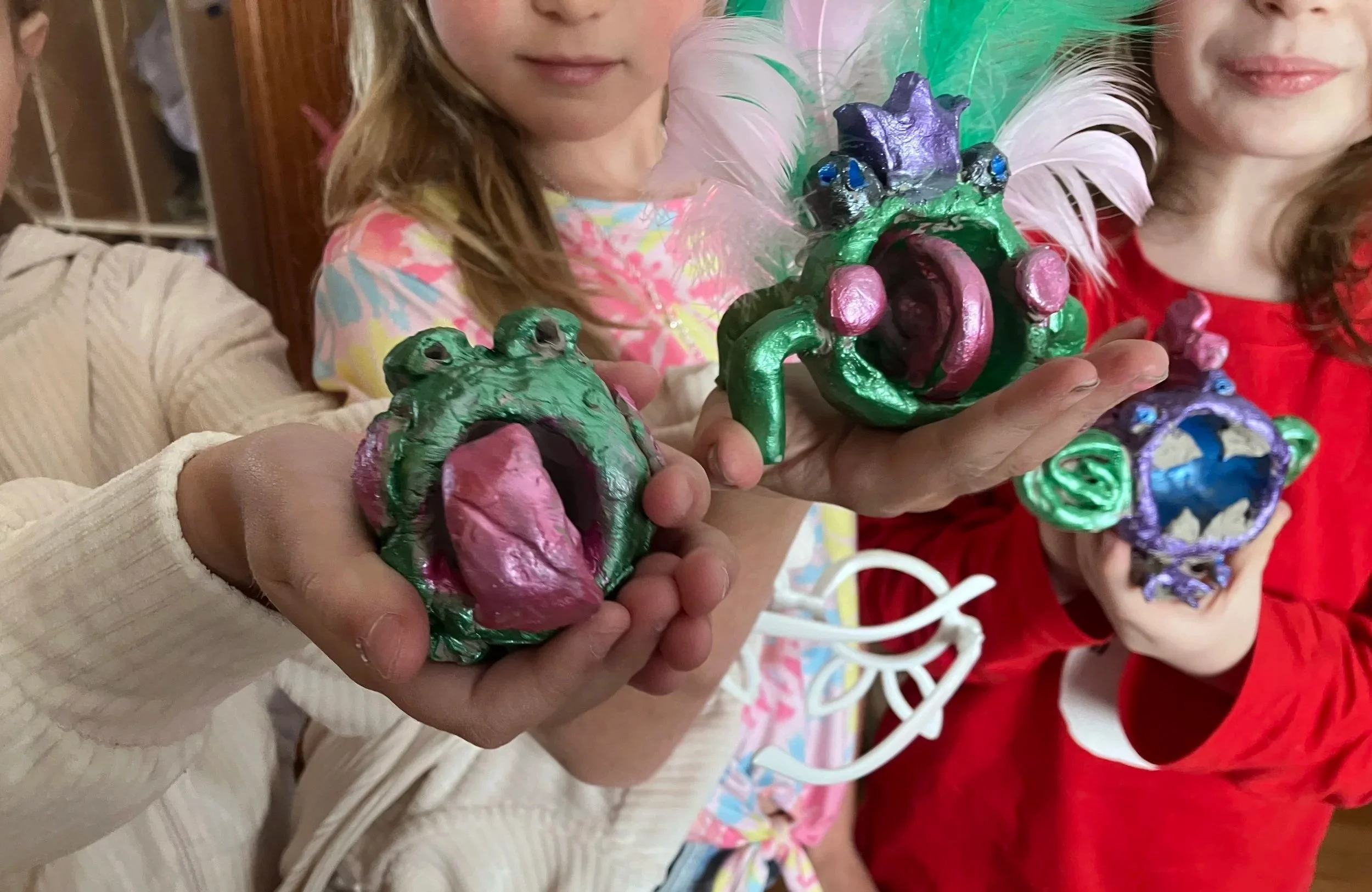
6. Amaco air-dry clay
Foam clay, which I shared in my list of best supplies for ages 3-5, is still a great material, but for kids who are ready to try something a little more traditional, I really like Amaco air-dry clay.
It's relatively easy to work with at home, doesn't require a kiln, and gives children the opportunity to make more substantial sculptures and objects.
A simple pinch pot is a great place to start. You can turn a pinch pot into a silly monster mouth, a fish, or a little container. One of my students turned a pinch pot into a fairy house, and it became the focal point of our art camp! Air dry clay is such a fun way to build a functional object or an entire tiny world.
One important thing to know: air-dry clay is not waterproof or food-safe. Even when it's completely dry, it will rehydrate if you put water in it. So while children can absolutely make little bowls, cups, and containers, they're decorative rather than functional for food or liquids. Make sure kids know that before they decide to make a drinking cup for their favorite stuffed animal!
7. Perler beads
I know, I know. Some people might categorize these as a craft supply rather than an art supply, but I'm including them because kids absolutely love them, and there's a lot more going on here than just following a pattern.
One of the things I love about Perler beads is that almost any child can find something that interests them. If they're into Minecraft, video games, K-pop Demon Hunters, animals, favorite characters, or geometric patterns, there is probably a Perler bead project for that.
They're also a sneaky way to introduce some really interesting mathematical thinking. Kids can explore symmetry, repeating patterns, color relationships, and geometric designs. For older kids, try giving them graph paper and having them design their own pattern before they start placing beads.
That planning process is a great exercise in thinking ahead, working backward from a finished design, and figuring out how to translate an idea into something tangible. It's design thinking disguised as an afternoon activity.
And if your child loves the pixelated look of Minecraft or 8-bit video games, Perler beads are basically made for them.
A heads up from someone who has never ironed a piece of clothing in her adult life: you do need an iron to finish these creations. If you don’t have one, check your local buy nothing group or thrift store!
Construction and making
8. A low-temperature glue gun
If your child is getting into cardboard construction, sculpture, or making more elaborate projects, a low-temperature glue gun can be a really useful addition to your art space.
Glue sticks and school glue are great for plenty of projects, but they don't always hold heavier materials together very well. A glue gun makes it possible to attach cardboard, fabric, wood pieces, and all kinds of found materials in a much sturdier way.
But once kids have access to a way to securely attach materials, the possibilities really open up.
For this age group, I'd look for a low-temperature model with a stable base and an easy-to-use trigger. This is a tool that requires adult supervision and some explicit safety instruction. Hot glue can still cause burns, even at lower temperatures, so you'll want to decide whether your child is ready to use it independently or whether it's something you'll operate together. When they are ready to use them more independently, make sure you cover unplugging the glue gun before walking away, and where you want them to put the glue gun so nobody like younger siblings accidentally touches it while it’s still hot. In our house, we use the stove to temporarily store glue guns until they cool down, because everyone knows not to touch the stove because it might be hot!
9. Cardboard scissors
If your child likes building with cardboard, get a pair of cardboard scissors designed for cutting thicker materials. Look for smaller-sized handles and blades with a bent or angled design that gives little hands more clearance when cutting through cardboard.
Regular scissors can be awkward to use on thick cardboard. Children's hands end up bumping against the material, their wrists get into uncomfortable positions, and the whole process becomes much harder than it needs to be.
The right pair of cardboard scissors can make a huge difference when kids are building structures, making costumes, creating sculptures, or turning a pile of boxes into something elaborate. This is one of those simple tools that totally changed our art studio!
10. A hole punch and paper brads
These two inexpensive supplies are a fantastic little toolkit for paper engineering.
A hole punch and a handful of brads let kids attach pieces of cardstock or cardboard while still allowing them to move. Suddenly, they can make puppets with moving arms and legs, spinning wheels, hinged doors, articulated characters, and all kinds of paper toys.
It's a really simple way to move beyond flat collages and start thinking about how objects are constructed and how different parts can interact.
You might be surprised by how much mileage kids get out of these two basic supplies.
A few final thoughts
One of the things I love most about having an art space available to children is watching their projects become more and more their own. At this age, kids are starting to develop specific interests, plan more complicated projects, and stick with an idea for longer periods of time. They don't necessarily need an adult to come up with an activity for them. They need access to materials that let them follow their curiosity and figure things out.
You don't need to buy every single thing on this list, and you certainly don't need to set up a professional art studio in your house. Start with a few materials that appeal to your child, make them accessible, and see what happens.
And if you have children of different ages at home, remember that many of the supplies in my art supplies for kids ages 3–5 list are still fantastic for elementary-age artists, too. A good art space grows with the kids who use it
Happy making!
Affiliate disclosure: As an Amazon Associate I earn from qualifying purchases. I only recommend products I genuinely love and would recommend to families based on my experience as an art educator.
