Why Your Kid Won’t Play Independently (And What to Do Instead)
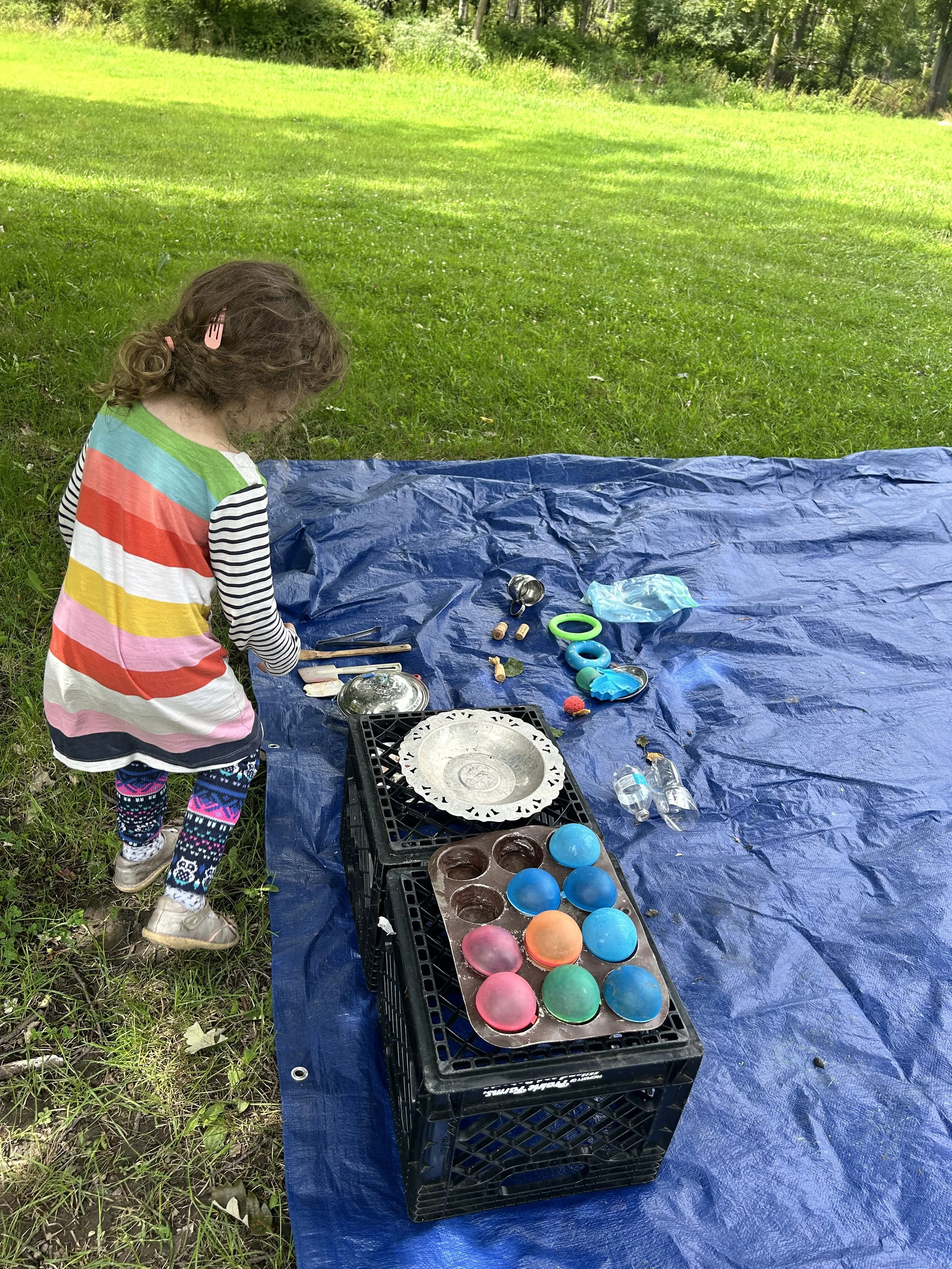
A child creates a restaurant out of household objects and repurposed toys.
If your kid asks you to play with them approximately 47 times before breakfast, I have some good news:
They may not actually be bad at playing. They may just be very, very used to you being the entertainment department.
I’ve spent more than a decade working with children in different educational settings, and for the past five years I’ve run Blazing Star, a child-led learning community where I get to watch kids play, explore, build, invent, obsess over things, abandon projects, return to them, and generally be much more interesting than whatever carefully planned activity an adult might have prepared.
I’ve also raised children while working, parenting, managing a household, and occasionally needing to pee without an audience.
So yes, I am very much in favor of children developing the ability to do things without an adult hovering over them.
But I think we sometimes misunderstand what independent play actually requires.
“Go play” is not really a plan
Imagine someone dropped you into a room full of supplies and said, “Go do something interesting.”
You might eventually come up with something. You might also stand there wondering what the hell they mean.
Now imagine you're four. Or six. Or eight, but you're tired, sensory-seeking, highly social, full of energy, or accustomed to adults organizing most of your activities.
“Go play” is a pretty enormous ask.
Play is something children do naturally, but that doesn't mean every child automatically knows how to generate an engaging activity from absolutely nothing. Some children need more support getting there than others, especially kids who are intense, active, sensory-seeking, highly curious, or deeply social.
Those kids are often not looking for an activity. They're looking for something interesting to happen.
And if you are the most interesting thing in the room, congratulations. You have been selected.
Your child may already be showing you what they want to do
One of the biggest shifts I've made in my own thinking about children is learning to pay attention to what they're already drawn toward instead of constantly trying to redirect them toward something I think they should be doing.
Your child is giving you information all day long. They're dumping out the kitchen cabinet, carrying water from one container to another, climbing the furniture, collecting rocks, putting tiny objects into increasingly tiny containers, taking things apart, lining up every animal they own, or making elaborate stories about one random cardboard box.
Those behaviors can be annoying. They can also be clues.
Instead of asking only, “How do I get my kid to stop doing this?” try asking, “What are they getting out of this?”
Maybe they like dumping because they enjoy filling, emptying, carrying, and transferring. Maybe they keep climbing because their body needs movement. Maybe they're dismantling everything because they desperately want to understand how things work.
You don't have to assume every annoying behavior is secretly a beautiful developmental opportunity. Sometimes your kid is just being a pain in the ass. Sometimes something genuinely needs to stop because it's unsafe, destructive, or completely incompatible with your life.
But often, the behavior contains useful information. And once you notice the underlying interest, you have somewhere to go.
Don't become your child's cruise director
This is where I think parents get stuck.
They realize their child isn't playing independently, so they start looking for things to give them. A craft! A sensory bin! A scavenger hunt! A printable! A complicated Pinterest setup involving seven containers and dried chickpeas!
And now, instead of spending less energy entertaining your child, you're spending even more energy preparing activities for them.
You do not need to become Your Child's Cruise Director™.
You need to start paying attention to what your child is already interested in and create conditions where they can pursue that interest with a little more independence.
If they're constantly dumping things out, give them things they are allowed to pour, scoop, sort, transfer, and mix. If they're climbing everything, give them opportunities to climb, balance, crash, build, and move their bodies. If they're fascinated by tiny things, give them cardboard, tape, scissors, string, containers, rocks, shells, or other appropriately safe materials. If they're taking everything apart, find something they are actually allowed to take apart.
The point isn't to create the perfect activity.
The point is to create an invitation.
Something that makes a child think, Ooh. I want to see what happens if I…
That's where independent play often begins.
Independent play doesn't mean leaving your child alone with a pile of toys
Independent play isn't necessarily about a child being completely alone. A child might play independently while you're sitting nearby. They might need you in the room but not actively participating. They might come find you every six minutes to show you something and then go back to what they were doing.
That still counts.
Especially when you're trying to build this skill, I wouldn't make the goal “My child should entertain themselves for two hours while I get things done.” That's a pretty enormous leap.
Instead, think about gradually changing the relationship between you and the activity. Maybe you start by playing together, then follow their lead while doing less. You sit nearby while they take over. You step away for a few minutes and come back.
Over time, the child learns something important:
I can make something happen here without an adult doing it for me.
That's independence. And like most forms of independence, it develops through practice and experience rather than through being told to be independent.
You don't have to manufacture curiosity
This is one of the things I've learned most clearly from running Blazing Star.
Over the past five years, I've watched hundreds of children turn tiny invitations into elaborate games, investigations, projects, stories, constructions, experiments, and obsessions I never would have thought to plan.
Sometimes an adult provides the initial material. Sometimes another child provides the idea. Sometimes it's something they found outside. Sometimes it's a question. Sometimes it's a piece of cardboard that apparently has tremendous spiritual significance.
The adult doesn't necessarily need to know where the activity is going. In fact, one of the hardest parts of child-led work can be resisting the urge to take over once a child has started doing something interesting. We want to improve it, teach something, make it more educational, suggest the next step.
Sometimes the best thing we can do is let the child have the next step.
You don't have to manufacture children's curiosity. They're already bringing it with them. You just have to notice it and give it somewhere to go.
And yes, you are allowed to want your kid to leave you alone sometimes. You are allowed to want to drink your coffee, answer an email, have a conversation with another adult, or sit on the couch and stare into space.
That doesn't mean you don't enjoy your child. It means you're a human being.
Your child benefits from developing the capacity to do things without constant adult direction, too.
The goal isn't to make your child independent because you don't want to deal with them. It's to gradually give them more access to their own ideas, interests, bodies, problem-solving, and ability to make something happen.
That's a much more interesting kind of independence.
So what should you actually do?
Start smaller than you think.
Pay attention to what your child repeatedly gravitates toward. Look for the pattern underneath the behavior. Then change the environment so they have more opportunities to pursue that pattern safely and independently.
And don't expect a magical transformation after one activity. A child who has been accustomed to having an adult generate every possibility for them may need time to develop a different relationship with their own attention.
You don't have to entertain them less by becoming better at entertaining them.
You can help them discover that they are capable of making interesting things happen themselves.
That's a very different project.
It's also one of the reasons I love child-led learning so much. At Blazing Star, I've watched children go from “What are we doing today?” to building elaborate games, investigating questions, creating projects, collaborating with other kids, and disappearing into something they're genuinely fascinated by.
Not because we found the perfect activity.
Because they had interesting things around them, enough space to follow their own ideas, and adults who trusted them enough to see where those ideas went.
That's the part I want more parents to have access to at home, too.
Want more breathing room?
I made a free guide for parents who are tired of being their child's entertainment department.
Why Your Kid Can't Entertain Themself (Yet) walks through why independent play can be hard, what might actually be getting in the way, why “just go play” often backfires, and how to create more opportunities for your child to play without you doing all the work.
